

IMPROVEMENT OF THE CONDITIONS OF THE TRANSPORT OF GOODS ON THE RIVERS OF SERBIA
In accordance with the Strategy of development of inland navigation of the Republic of Serbia from 2015 until 2025, water traffic has been identified as the most convenient type of traffic for transport of large quantities of exported and imported goods. For the purpose of creating of a necessary European navigation network, the most important aspect of development of inland navigation is removal of tight passages, as well as of the missing connections on the inland waterways.
The current conditions on the inland waterways of Serbia requires immediate intervention in order to establish the former level of river navigation. This requires rebuilding of demolished facilities, cleaning of waterways of unexploded projectiles, wracks and ruins, rehabilitation or renovation of navigable channels and poorly maintained port facilities, as well as modernization of the outdated equipment. For the purpose of realizing these goals, a Master Plan of inland waterways in Serbia was been prepared, as well as three feasibility studies. Based on the results of the analyses made in the Master Plan, a list of priority projects for each river was made:
- Danube
– Excavation and the works in the navigable channel,
– Construction of a new railway bridge near Novi Sad,
– Reconstruction of navigation locks “Djerdap 1“ and “Djerdap 2“,
– Removal of ship wrecks from World War Two near Prahovo.
- Sava
– Excavation and works in the navigable channel.
- Tisza
– Excavationand works in the navigable channel,
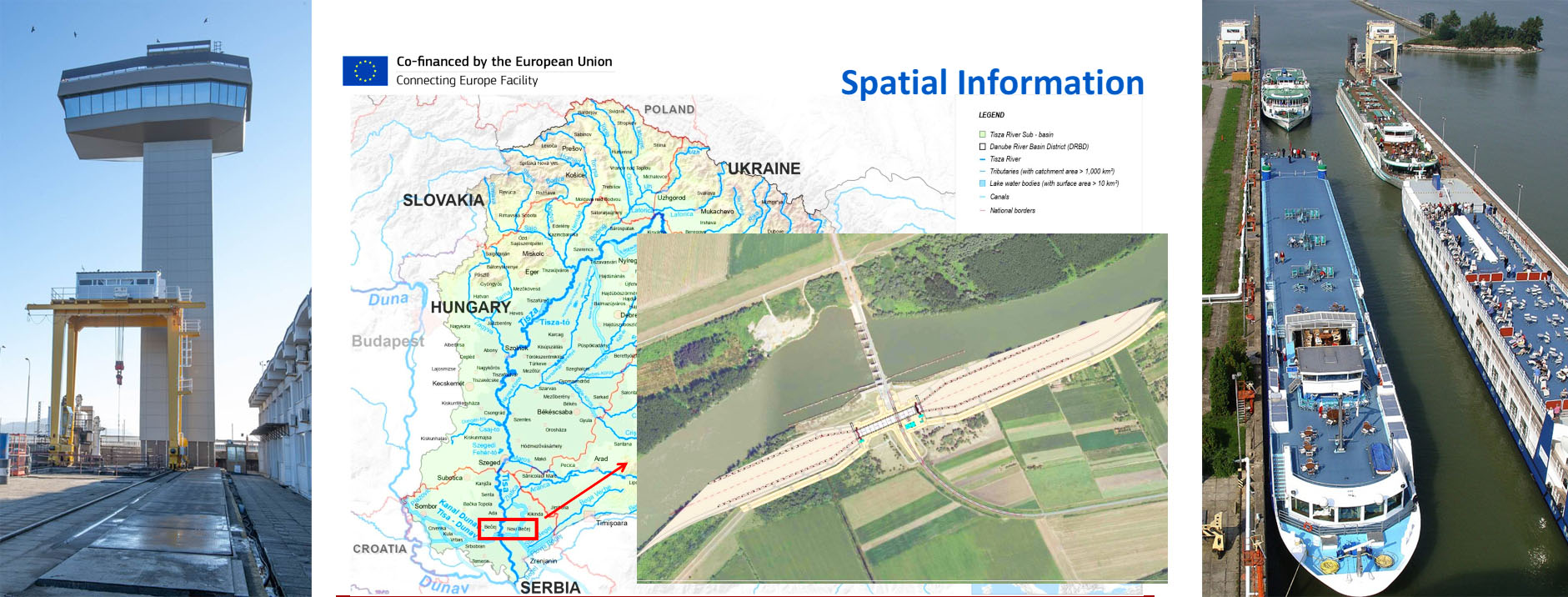
– Extension (construction of a new) navigation lock near Novi Becej,
– Removal of sunken ships.
- Danube-Tisza-Danube hydrosystem
– Excavation setting out and the works in the navigable channel,
– Repair of navigation locks,
– Repair of bascule bridges,
– removal of remnants of pontoon bridge near Novi Sad,
– Construction of a new bridge on Vrbas-Bezdan channel and
– Different projects pertinent to all three rivers and hydrosystem: improvement of the harbours of safe refuge, navigation vehicles, waste collection systems, implementation of radio-communication system and river-information service.
In accordance with infrastructural policy of the European Union in the field of navigation and planned development of Rhine-Danube Corridor, which is one of the nine European corridors of the Trans-European Transport Network, the project of reconstruction of navigation lock on HPNS “Djerdap 1” was successfully realized in the previous period, whereas the implementation of the project of reconstruction of navigation lock on HPNS “Djerdap 2” is in progress.
Navigation lock of HPNS “Djerdap 1“
Navigation locks for regulation of inland navigation from lake to river and vice versa have been built within the structure of HPP “Djerdap 1“, one on the Romanian and one on the Serbian side. Construction of navigation locks meant overcoming the height difference from 21 to 34 m, determined by the inflow of Danube River. Navigation locks on both sides of the Danube are double chamber navigation locks with 310 m long аnd 34 m wide ship chambers. The possibility of increase of the clear opening for guiding from 10.5 m to 13.5 m through lifting of the crane rail supports of a 400 t crane and 5m draft on the sill of the navigation lock enables navigation of inland-seagoing vessels.
Throughput capacity of a navigation lock in one locking cycle is reflected in guiding a convoy of a pusher and nine barges with maximum length of 290m, width 33m and load-bearing capacity of 17,000 t. According to its size, this navigation lock is among the biggest in the world. It is even a bit bigger than the navigation locks on Panama channel.
Rehabilitation works on the reconstruction of the navigation lock have been successfully completed in the period from 2019 until 2021. Owing to the reconstruction, ship guiding time is shortened from one hour 50 minutes to one hour, the number and duration of unforeseen navigation delays are reduced and the safety of the operation of the navigation lock is increased.
The useful life of equipment on navigation lock is extended for the next 40 years, the costs of maintenance are reduced by 30 percent, and the environmental impact of the operation of the lock is reduced.
Average number of vessels guided through the lock was approx. 6,300, whereas the newer equipment will enable passage of 10,000 vessels annually.
Navigation lock of HPNS “Djerdap 2“
Two navigation locks operate within hydropower and navigation system “Djerdap 2“, whereas the Romanian navigation lock was built on the channel cutting through Mare Island. Navigation locks are single chamber locks, with one chamber of the same dimensions each. A convoy of 10 vessels, with 14,000 t of load and maximum draft up to 5m and height up to 12.5 m can pass through them in one locking. Higher vessels, such as seagoing ships, can be guided with previous announcement and in a special mode. Guiding duration is 40 to 60 minutes, depending on the type and composition of a vessel.
Preparation of design documentation by the contractor and equipment supplier for the reconstruction of navigation lock “Djerdap 2” is in progress. A decision for construction approval was obtained based on the previous documentation prepared by Energoprojekt Hidroinzenjering. The construction on the project is expected to begin in mid-2023.
Design provides for the following works:
– Repair of the control tower gondola;
– Reconstruction and modernization of process rooms;
– Reconstruction of the existing internal roads of the navigation lock;
– Repair of a part of embankment of downstream fore-dock;
– Repair of the damage on the concrete surfaces of the lock;
– Replacement and reconstruction of electrical installations;
– Repair and adaptation of electrohydraulic drive installations and hydromechanical equipment for gates and valves, safety net intended for ship braking, inlet trashracks;
– Repair and adaptation of cranes, discharge and drainage system, system for automatic greasing of operating doors, mechanical equipment of the fixed fire suppression system;
– Reconstruction of the navigation lock management system.
Navigation lock on Tisza River
By entering the European agreement on waterways of international significance by the Republic of Serbia, Tisza River in its entire length within the Republic of Serbia of 164 km became a river of international significance. After the Danube navigation locks, the process of implementation of the project of improvement of the conditions of ship guiding is continued through the current project of expansion of the capacity of the existing navigation lock on Tisza River, i.e. construction of a new navigation lock, in the immediate vicinity of the existing one, near Novi Becej.
With signing of the Protocol of Cooperation in implementation of the project for improvement of the conditions for ship guiding on the Tisza Dam, a new perspective of river transport is opened, investments in ports are made possible and performance of the port in Senta is increased. In addition to this, the possibilities for additional investments in river infrastructure are opened, primarily in Banat.
The existing navigation lock on Tisza River is a narrow passage in navigation and reduces the category of the waterway upstream from the navigation lock. In order to eliminate this problem, the design for improvement of the conditions for ship guiding within the Tisza Dam, which is presently being prepared in Hidroinzenjering, provides that the category of waterway be expanded, thus enabling the passage of not only one, but several bigger vessels and trains consisting of the thruster with two barges in two rows.
Implementation of this project is an incentive for the economic development, not only of the local self-governments, but of the entire country as well, with drastic increase in water transportation on the Tisza River, which is of great significance for environmental protection and ecology. Increase of inland navigation will reduce the frequency of road traffic and, since the inland navigation is environmentally preferable, emission of harmful gasses with be reduced.
Since the last overhaul of the existing navigation lock on the Tisza Dam was carried out 15 years ago, and since there is visible damage, the rehabilitation of the existing navigation lock has begun. Preparation of design documentation is in progress and we expect that the conditions for commencement of works will be fulfilled soon.
All of these activities are important since an international agreement on the Tisza River navigation was signed in 2017 between the governments of the Republic of Serbia and the Republic of Hungary, giving the river an international significance.
The design of the new navigation lock on Tisza River is a very important infrastructural project which could lead to significant progress of transport and economic ties of Serbia, not only with Hungary, but with many other countries of the Central and Eastern Europe. Tisza River was marked within TPP Nikola Tesla Project as one of the important waterways in Europe.
In the design development phases prepared so far, a technical solution was selected that meets all the design criteria specified so far. Individual elements of this technical solution will be additionally considered and optimized in the subsequent design phases.
New navigation lock on Tisza River is the biggest structure of this type which will be built in Serbia in the last several decades (HPNS “Djerdap 1“ was built in 1972, HPNS “Djerdap 2“ in 1984, the existing navigation lock on Tisza River in 1975) and, as such, will have a big technical and technological significance, since it will be made in accordance with the current internationally recognized standards.
The goal of realization of this project is to ensure building conditions prescribed by the Law on improvement of the conditions for ship navigation (transport of goods) within the Tisza Dam, as well as the increase of navigation capacity, so as to enable simultaneous navigation of more than one vessel.
For all of the above reasons, the development of this project is of high importance for the region and for Serbia.