

COMPLETION OF A STUDY OF STRATEGIC IMPORTANCE FOR WATER MANAGEMENT OF ALGERIA
In the beginning of October, Energoprojekt Hidroinzenjering submitted and presented the spatial data base, as the last activity in realisation of the Study of Provision of Water Resources in Northern Algeria.The presentation was conducted before the engineers of the National Agency for Dams and Transfers (Agence Nationale des Barrages et Transferts – ANBT).
The Study covered the area of Northern Algeria of approx. 300,000 km2. This area is inhabited by more than 80% of the total population of Algeria. The area is divided into four hydrological regions and includes 41 wilayahs (provinces) and 1,406 communes (municipalities). Preparation of this study, which was carried out in five missions, included:
- Diagnostics of the current situation and analysis of hydraulic system;
- Gathering and critical analysis of data and forming of a data base;
- Modelling of hydraulic systems;
- Simulation of optimization systems and analysis of its results;
- Proposal of building management and system.
In realisation of the study, a large amount of spatial and non-spatial data was gathered. The following data were gathered:
- Demographic data on the level of administrative units – communes
- Data on the water demands of the population, industry, agriculture…
- Different cartographic data (digital model of the terrain, topographic data…)
- Data on desalinization and water treatment plants
- Hydrographic data (river network, lakes, catchment areas of stations and dams, hydrographic regions)
- Climatological data (maps of precipitation, runoff, evapotranspiration and temperature)
- Data from rainfall and flow metering stations with measured values (for 959 rainfall stations with measurements since 1859, and for 179 flow metering stations with measurements since 1942)
Data on hydrotechnical structures (general information on the structures, technical characteristics of run-of-the-river structures, morphological and operative characteristics of the reservoir, water losses dueto leakage, technical characteristics of transfer structures, data on the operation of dams in use).
There are currently 70 large dams (Djorf Torba and Brezina dams are located outside the project area), out of which, 65 are in use. Apart from the ones already built, construction of 14 more dams is in progress, whereas 18 dams are in the final design phases. All of these dams will, upon commissioning, constituteand integral part of the system for surface water harvesting, abstraction and distribution to consumers all over the territory of Northern Algeria. This study includes 33 transfers in use, under construction or in design process.
Apart from the data collected from ANBT and other state agencies of Algeria, some data, necessaryfor quality realisation of the Study, have been taken over from the strategic regional projects previously realised by Energoprojekt Hidroinzenjering on the territory of Northern Algeria:
- PMH (Petite et Moyenne Hydraulique – Small and medium-scale hydraulic perimeters)
- ORSEC (Organisation des secours – Emergency Plan)
- CRESNA (Carte des Ressources en Eau Souterraines du Nord de l’Algérie – Map of the ground water resources of Northern Algeria)
Apart from that, data from the projects of individual dams currently prepared for ANBT and the territory of Northern Algeria, which had been submitted by the client, have been taken over. The gathered data were critically analysed and processed for the purpose of creating a base of data which could be used in the course of project implementation. Critical analysis of the collected data constitutes a filtration of the original records for obtainment of error-free data sets which would form parts of a unified database. Their processing implied analyses made for the purpose of obtainment of coherent data which would represent input parametersfor later simulations of system operation.
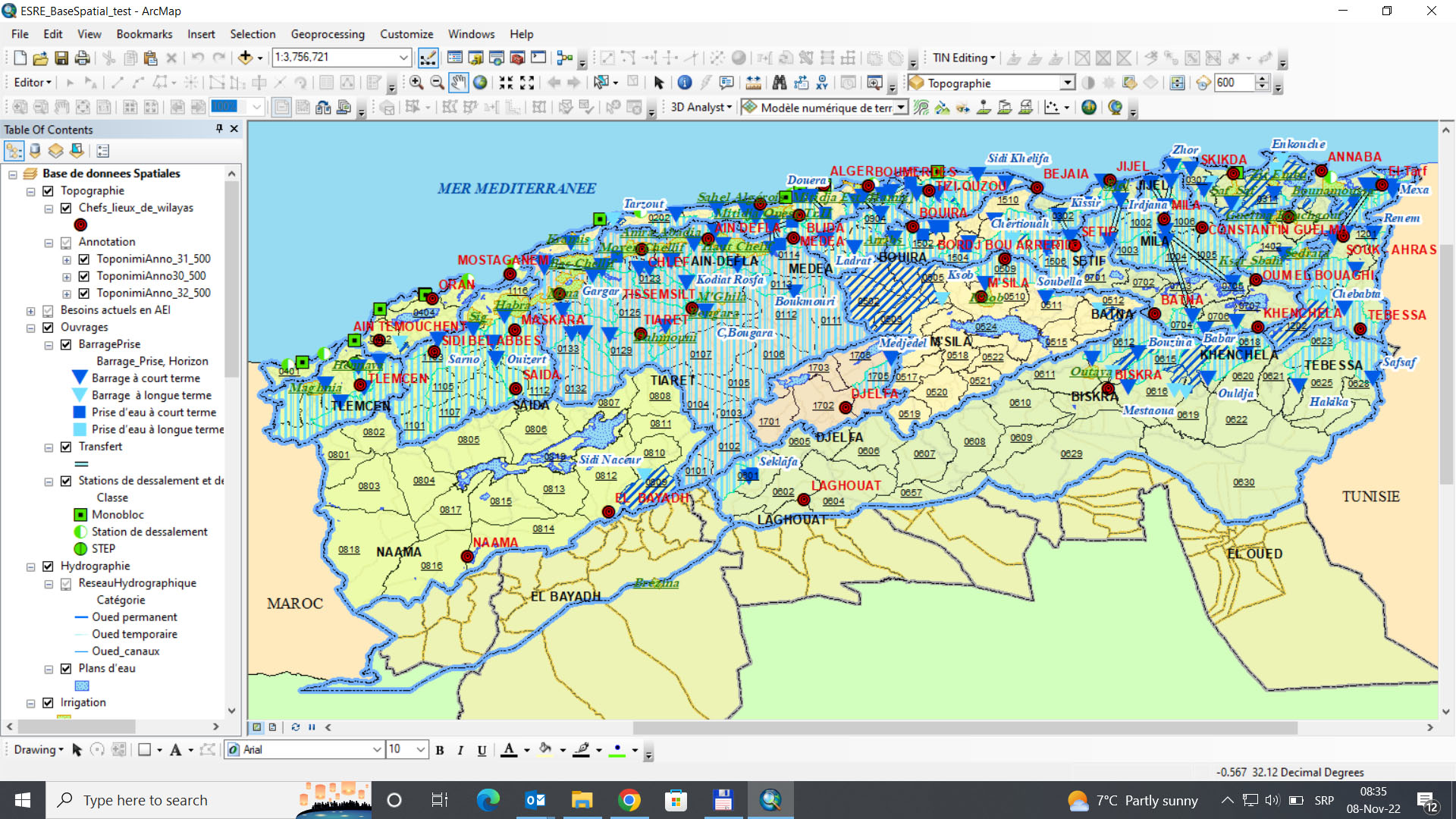
Gathered alphanumeric and spatial data are organised in a unified spatial database. This base enables storage of a large quantity of data, their analysis and visualisation. The base is designed to enable easyand intuitive search of the data, visualisation and communication with specialised software for simulation of the operation of reservoirs.
The primary purpose of this base is unifying data for easier and faster viewing of both spatial and alphanumeric data. Spatial database was made as flexible in terms of entry of new data and editing of the existing data. In this project, database was created as ESRI personal geodatabase version 10.6.
Apart from the data gathered in Missions 1 and 2, this database also stores system modelling data, results of complex system simulations, as well as proposals for management of the structures and the system, realised in Missions 4 and 5. The results of the simulations of different scenarios were organised in six tables containing alphanumeric data. This data is relationally tied to spatial data of the dam (Barrage Prise). The data of the results of the simulations of different scenarios consists of the following:
- Data on deficiency of water for transfer, irrigation or water supply / industry,
- Data on the water demands for transfer, irrigation or water supply / industry,
- Data on water levels in the reservoir,
- Data on provision of water for transfer, watering or water supply / industry,
- The results of the simulation which contain the data on the total inflow into the reservoir, spillways, net evaporations, leakage through dam, irrigation and water supply,
- Data on water volume in the reservoir.
With completion of this Study, Energoprojekt Hidroinzenjering continued a series of successfully realised regional strategic studies in the field of water resources on the territory of Algeria. Contemporary approach maintained by Energoprojekt Hidroinzenjering, as well as following of trends in projects that contain geospatial data has been recognised on Algerian market and is a good recommendation for future projects in the region.